In the last post, I introduced Elphabese, the cipher used in the Wicked hub. The cipher only works if players can actually learn the script. The first puzzle in each of the hubs is meant to be simple and relatively-quick. I’ve seen other escape rooms place one or two posters around the room with a sort of key, letter to glyph. I wanted something that felt more natural and in-universe.
The real Rosetta Stone solved a version of this problem. The same decree, inscribed in three scripts: hieroglyphs, Demotic, and Ancient Greek. Scholars already fluent in Greek held the key. By comparing the scripts, they worked out the hieroglyphic mappings. Same content, different scripts, one meaning.
I’m aiming for something similar here. Elphaba’s grimmerie is the centrepiece of this hub (more on that later). Players will find it sitting on a desk. The Rosetta stone for this cipher is excepts from the grimmerie, four torn-out pages causally lying on the desk. Each page will contain a short spell, written in the cypher glyphs as well as in a sort of pseudo-Latin.
One decision worth explaining: the second line is pseudo-Latin, not English. There are a couple of reasons for this. The first has to with pronunciation. I wanted spells to be used to progress from one puzzle to the next, I’ll be using electronic speech recognition to make this happen. For this to work, the decoded spells need to crafted to have only a few, predictable pronunciations. That meant using made-up words.
If we’re going to use made-up words, they should fee like they come from another language. Latin seems to be used a lot for this in the fantasy genre, and I can see why. They aren’t real words (even in Latin), but they feel magical. Because the transitional spells will use pseudo-Latin, it makes sense that the Rosetta Stone device should too.
The grimmerie pages also include an English “translation”. I’m putting these on the bottom of the page to make it clear that this is not the text to be matched with the glyphs. Eventually I’d like to use real (or real-looking) handwriting for the English part, but my handwriting isn’t good enough for that.
The glyph alphabet has one more layer to it: each glyph has a name, and each name starts with the letter it represents. The Flame maps to F. The Arrow maps to A. Players who notice this can confirm their mappings quickly, even without the bilingual sheets in front of them.
Four of these spell sheets can be found on the desk. Each covers a different spread of letters, teaching different parts of the alphabet. The first is Flamma et Lux — Fire and Light.
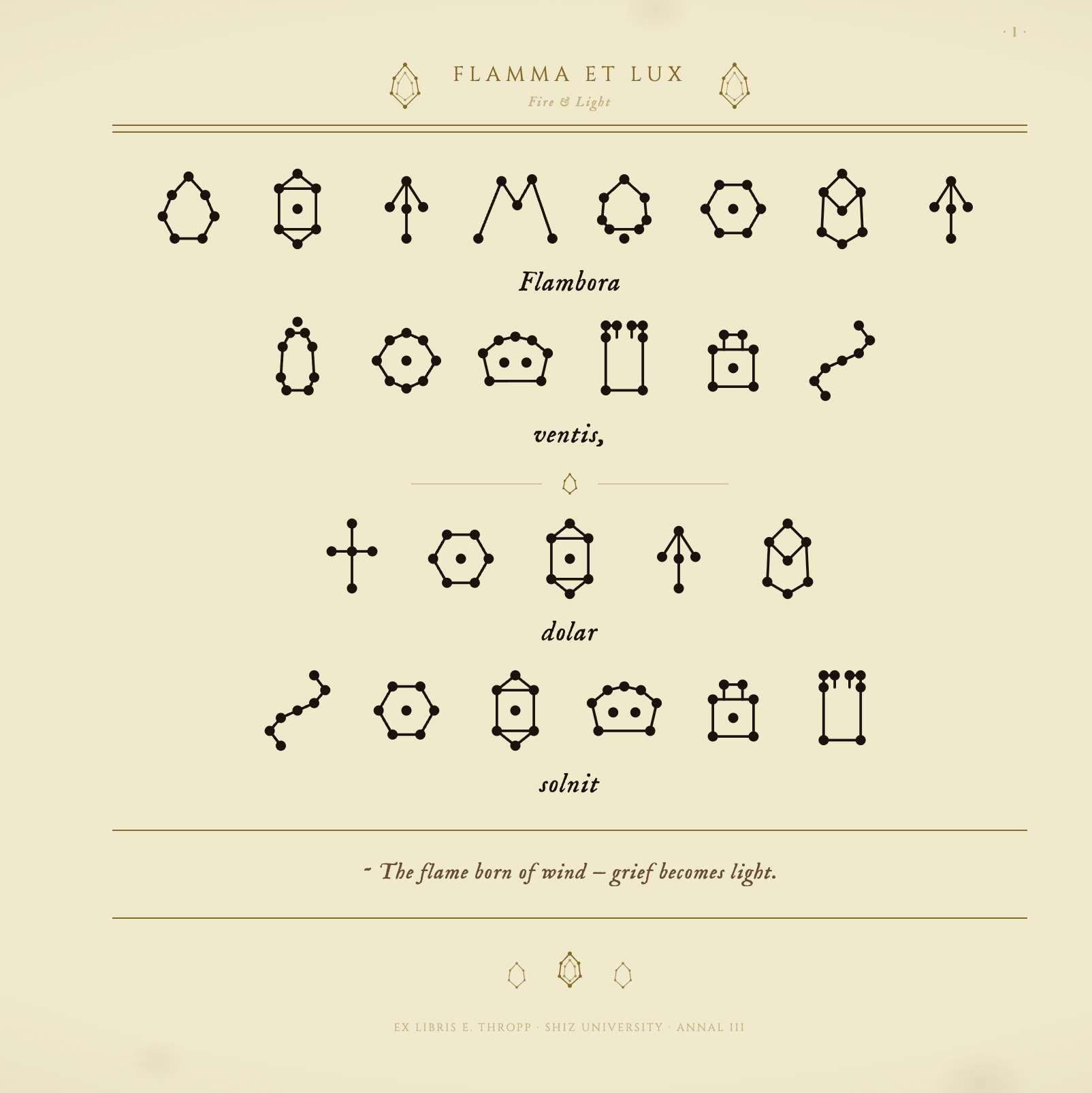
This exposes fourteen unique glyphs. That’s more than half the alphabet, but doesn’t quite cut it. It’ll have to be combined with the other pages to fully decode the first puzzle.