One of the early design decisions for this project was that each of the four hubs should feel genuinely different. Not just in theme, but in how you think. Every group of players should be using completely different mental muscles — so that when the groups reunite at the end, nobody has accidentally given the game away.
That means giving each hub its own puzzle type. One group will be breaking a code. Another will be hunting for something hidden. A third will be sorting and ordering. And the fourth will be piecing together a sequence. The goal is for each hub to last 30 - 45 minutes, but to feel like completely different experiences.
Wicked gets the cipher.
The Setting
We’ll be using my office, with the entire group in the same room. So, we’ll split the room into quadrants, one for each vault or hub.
The first vault is Elphaba’s study: a dim, layered space that feels like it belongs to someone brilliant, unconventional, and not particularly interested in visitors. Strange books, stranger notes, a desk that clearly sees more use at 2am than at noon. The atmosphere should feel slightly unsettling — the good kind of unsettling, where you’re not sure if you’re trespassing or being invited.
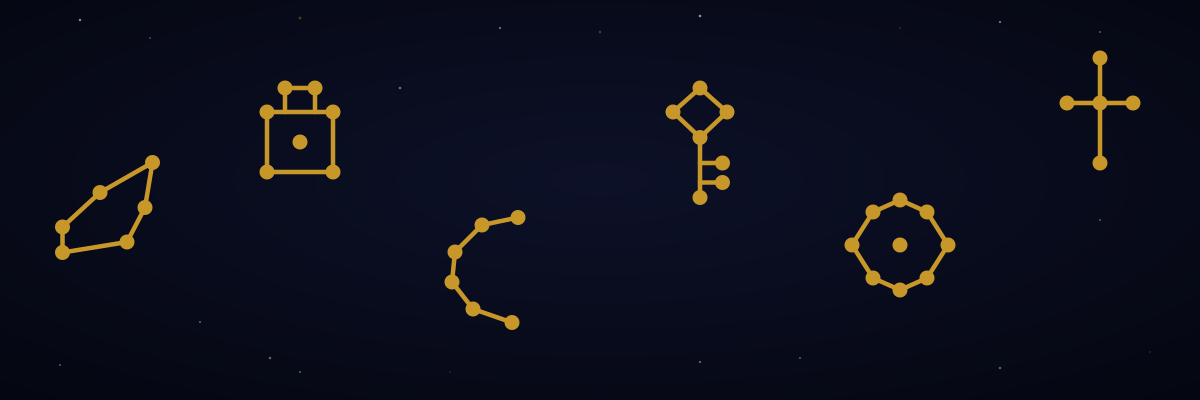
Scattered through the props and materials in the room is a writing system that doesn’t belong to any language the players have seen before. It looks a bit astrological.
The Puzzle Mechanic
The core challenge is code-breaking. Players encounter a custom script — one I’ve been designing specifically for this build — and have to decode a hidden message using only what’s available in the room. No knowledge of the musical is needed. No prior experience with cryptography required. Everything they need is there.
The script is built around a consistent visual logic. Each character is constructed to look like a constellation. This is a working draft, I intend to refine it to make the dots resemble stars a bit more. The symbols aren’t just arbitrary, there’s a pattern to it. The idea is that they could just match the symbols up, or they might discover the pattern, which would speed up the decoding. Here’s a sample of the first iteration:

The puzzle escalates as players work through it. The early steps are accessible — designed to get both players actively engaged (remember we’re splitting the group up, with two to three players per hub). By the end, they should feel like they’ve genuinely cracked something.
What Players Experience
Two or three players arrive at Elphaba’s study. They find the script almost immediately, but can’t read it. They find something else — also in the study — that helps them begin to decode it. The challenge is connecting those two things, and applying what they’ve worked out.
The physical experience is important here. This isn’t a puzzle you solve on a screen. The materials are in the room, handled, referred back to. There’s something satisfying about holding a piece of paper with an encoded message and slowly working out what it says.
When they crack it, the TV fires a short clip — Elphaba’s vault unlocks, the scene vaults release their grip on the curse, and the players carry their artefact (a small green vial) to the finale table.
What Comes Next
The Elphabese alphabet is designed and complete (though I’ll continue to refine it). The overall puzzle structure is clear in my head. I also know how I want to present the code and the decoding hints. I’m hoping to share the general idea here without revealing the exact details (which would contain the solution).
I’ve got some ambitious ideas for how I want to present the puzzle (hint, it involves an e-ink screen and an ESP32). I’ve ordered the materials and I’m really excited to see how it turns out.